Prior to the American Revolution the majority of colonists thought of themselves
as British, respected English law and did not want to rebel against their King or change their agreements by force.
The thirteen colonies were Crown property and most settlers, including the Pilgrim Fathers (who only made up a third of
those arriving on the Mayflower, the rest were radicals), agreed to work for a limited period under the terms and conditions
of an indentured employee in exchange for free passage, a land grant negotiated with the Indians and a much better
lifestyle than their counterparts in Britain.
In most respects the American colonies governed themselves, but as they started to expand, border disputes with New France
increased. So Britain was obliged to deploy regulars to maintain an uneasy peace with the French and also protect colonist’s
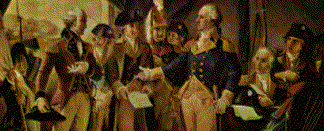
homes from Indian depredations. This truce lasted until a 22 year old lieutenant colonel in the British army, a certain
George Washington had his men launch an unprovoked attack on French troops at
Jumonville Glen in 1754, killing 10 of them and murdering their commander.
This effectively sparked off the seven-year war (1756-63) during which the French tried to drive the (non-French) colonists
out of America.
To defend them, Britain had to increase its troop numbers in the colonies to ten thousand men. This is because when the
colonists were left to their own devices, they nearly always lost, George Washington was particularly useless getting himself
captured by the French; (it wasn’t until the revolution that he became an outstanding General).
Despite the colonists being comparatively wealthy, with some very wealthy, the cost of this protection was nearly all being
borne by the British taxpayer and the seven-year war had added 150 million pounds ($280,500,000) on top of an already
crippling debt, incurred while defending Hanover from the French, Austrian, Saxon, Swedish and Russian Alliance.
This deficit was made worse by corruption in the colonies actually causing tax revenue to cost Britain £8000 in order to
collect £2000 tax, and this at a rate of only sixpence a year each.
The British had repeatedly tried to get the colonists to pay towards their protection, by introducing various taxes, but
all were unpopular.
So after the seven-year war the British had a massive debt with few ways to reduce it, so they had to limit expenditure and
as the colonists had been the beneficiaries, it was decided:
1. The settlers were to stop taking more and more Indian land, to limit spiralling defence costs and adding to the
debt burden
2. The settlers were to stop murdering the Indians (many of which had helped defeat the French), so as not to upset the
only money maker in America, that of trading for Furs
3. They had to stop endemic corruption such as smuggling and bribery, that was costing the exchequer so much money
4. They had to find a way of introducing a tax system that worked to help with the debt burden.
No taxation without representation, the rebels said, but they did have representation through the
colonial legislature/governor and had only been paying one twenty-sixth of the tax that a British tax payer paid,
who were effectively subsidizing them by bearing the burden of their protection.
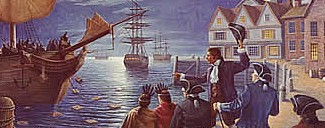
Despite its notoriety, the objection to tax levied on tea was a ruse; the real issue was the British had, in an attempt
to curtail their activities, under-cut the price of tea offered by smugglers, so it’s not surprising that most of the
revolutionary leaders were in fact smugglers.
But what is less well known is these same leaders had become wealthy dealing with the enemy during the Seven-Year-War,
while fellow Americans were fighting to help save the colonies from the French.
Another reason not often mentioned is that the local legislatures for their own ends, kept devaluing their currencies
to the point of making them virtually worthless. This cheated creditors out of money; but also created large numbers of
debtors in the colonies.
The money owed wasn’t theirs to lose, so by promising to absolve these debts, the rebels devised a powerful incentive for
support.
The British had also drawn a proclamation line along the Appalachian Mountain peaks, honouring agreements to limit further
encroachment onto Indian land and arrest the spiralling cost of protecting the colonists from Indian reprisals.
Therefore those that settled beyond this line were the cause of a lot of problems as not having any money; they just became
adept at murdering the Indians in order to take their land. Such people put extra strain and expense onto the British defences and
were of course the natural allies of those powerful colonists, such as George Washington who wished to benefit from Indian
land speculation.
Then a Habeas corpus case (having to justify the reason for someone’s detention) was started in London 1771, which found
that slavery was contrary to the laws of England. This verdict ultimately led to the abolition of slavery in
Britain. The ramifications of which was not lost on the future rebel leaders as most being slave owners would have considered
it a threat to their livelihoods.
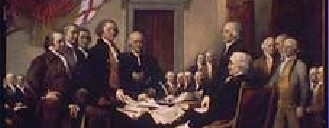
The rebel leaders or founding fathers (all
quasi-atheists e.g. Deists) only represented
about 27% of two and quarter million colonists (although they said it was 33%), but even if this was correct they knew they
would have never won power through a referendum, so as they possess considerable
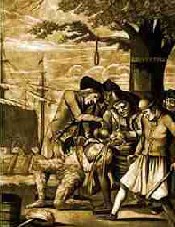
propaganda skills, they called themselves Patriots, contrived incidents like the so called '
Boston massacre', portrayed their own vested interests as philanthropic ideals, and incited a reign of terror, aimed
at civil authorities to disrupt society.
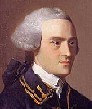
In reality Hancock was a very weathly smuggler, but the British had undercut his overpriced business and sommoned him to
appear in court at a time he and Samuel Adams were known to have been in Lexington, where the shots of
unknown source were fired at both sides resulting in several Militiamen being killed.
The others including Sam Adams (a failed businessman accused of embezzlement), Allen, Paine, Franklin, Jefferson, and Madison
were bitter men, who for various reasons held grievances against the British.
The British only really wanted the smuggling and bribery to stop.
The rebel's strategy of attacking Loyalists, tarring and feathering them etc. to force them to resign their posts could
have provided a role model for Hitler in the 1930's, as they also took advantage of unemployment to form their own
militia, training them to take on the army (redcoats) while at the same time as appealing to everyone's sense of 'freedom',
were really manoeuvring to dominate the colonists, majority of which were apposed to them.
They were in fact, what we consider today as insurgents/terrorists and those that most loudly espoused 'freedom', were
controlling the largest number of slaves.
Washington had become one of the wealthiest men in the Americas by marrying into as much money as he could and was anxious
to gain even more through land speculations, if the Indian's land, which was being protected by Britain could be seized,
so it's not surprising he wasn't the type to want to pay any taxes.
But it could be concluded that this motivation of greed had transformed him from a mediocre general under the British into
an outstanding General, but he was at least as harsh on his troops as any British commander or even more so, as he would
extend any lashing over several days for those he disapproved of, waiting for wounds to scab over before having them opened
up again, then time and time again.
The one-sided accounts generally given by American historians, websites and film makers don't often
mention the Battle of Penobscot Bay, probably because a mere 50 British redcoats held off 3000
Rebels for several days, until the Royal Navy arrived, at which point they embarked their 40 ships,
but only to sail up river where they managed to shipwreck themselves and disappear into the Maine's wilderness never to
be seen again.
The Loyalists were about 40% of the population overall, (Long Island was 90% Loyalist) and those
that just didn’t want to be on the losing side (including 'late' loyalists), made up the remaining 33%.
The Loyalists being law abiding were originally passive relying on the British for protection, but
after they became increasingly persecuted,
terrorised and humiliated by the rebels, about 15,000 joined as provincials with the British Army and another 10,000 served
part-time with the various Loyalist militias. Many of who became highly motivated after
experiencing rebel brutality, an example of such a person is Thomas Brown the son of a merchant, who had tried to confront a
gang of the Sons of Liberty, but they attacked him, fracturing his skull, then partially scalped him, tarred his legs and held
him over a fire with which he lost toes. The evil behind this revolution apparent, he went on to recruit hundreds of men to
serve bravely with the East Florida Rangers, the unit that held off Mad Anthony Wayne for 6 months allowing everyone to
evacuate Savannah safely. But as usual with such a determined leader, he has since been vilified by US historians.
Those Loyalists that remained passive and the Non-aligned were forced under the threat of death to swear and sign oaths
of allegiance to the rebel cause.
This turning it more into a civil war the rebels put their propaganda machine into overdrive, claiming
things like ‘Tories’ took babes from the breasts of their mothers to dash their brains out and the alleged
Tarleton’s quarter.
Also the rebels recruited reprobates who had evolved a Presbyterian religion that as good as justified carrying out
inhuman war crimes against Loyalists and keeping redcoat prisoners in
such appalling conditions that most died.
Anglican clergymen give testimony to this, as when they had previously ventured to into places such people had settled,
they found their lives ‘low, lazy, sluttish, heathenish, hellish and when trying to perform a church service, they always would
turn it into a drunken singing revelling and dancing orgy.
An example of what these 'From over the mountain' people were capable of, was at the battle of Kings Mount
where having surrounded a heavily outnumbered Loyalist unit, whose position had became hopeless so had (despite rebels
not usually taking Loyalist militia as prisoners), tried to surrender; they just cut Major Ferguson to pieces
and violated his body and this to a man whose chivalry in battle had prevented him from shooting Washington in the back.
Also if any other examples of barbarity were required, they then used this distortion of religion to justify firstly starving
those prisoners that they did take, only to hang or shoot most of them later.
While the British won most of
the battles,
(despite often being outnumbered ),
the conflict was really won by France
Spain and Holland who also declared war on Britain with Russia Sweden and Denmark also denying trade. The coup-de-gráce was
when French ships blockaded Chesapeake bay denying Cornwallis any relief and then a storm prevented him from retreating
across the river, giving him no choice but to surrender.
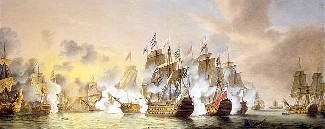
These same French ships then went on to the West Indies where Rodney's fleet (who were one week too late to
save Cornwallis), caught up with them and smashed them to pieces.
The French officers that had fought alongside the rebels were surprisingly conciliatory towards Cornwallis's men on their
surrender at Yorktown, it's as if they knew their hypocrisy would rebound on them, they had fought a devious war to first
aid the American rebels to remove the British, then (which isn’t well known) to try later on to regain lost territory by
going to war with the Americans themselves. Although an undeclared war, the French did actually try this in the
Quasi-War but luckily for the Americans, Britain changed tactics and
left them too stretched to finance it beyond inflicting terrible losses on American shipping.
Britain could have fought on in America, but with her very existence under threat, wisely decided to consolidate her
forces to fight France and Spain directly and in doing so defeated them, which actually protected the Americans.
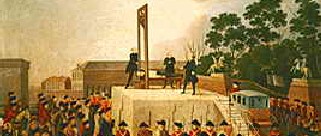
The French people were left so impoverished by all this that their leaders, who had decided to fight with the American
rebels, then suffered by their own example when having made inevitable the rebellion against King Louis XV1 and his
entourage, they where duly executed in the French Revolution
Spain would also suffer a considerable loss when later her own colonies followed the American example.
During their rebellion the American republicans had relinquished almost universally their religion and morality, to a point
that they drove most true church ministers out of the country which mitigated recriminations when the vast majority of ordinary
Americans did not gain as a result of the rebellion, in fact most lost out, with the soldiers not receiving the land or the
amount of pay they were promised, the Blacks remained as slaves and the Indians were subjected to ethnic cleansing. Only some of the
rebel leaders gained and they imposed far more taxes upon the people than Britain would have done and also set up the
monopolies that was the
real cause of the north v south civil war, emancipation of slaves only became an issue to defeat the south.
But what happened to the Loyalists was similar to what happened in Europe to the Jews during the 2nd World
War and would have probably experienced the same fate, had the most venerable of them not fled, (mainly to Canada). The
expression ‘Lynch Mob’ comes from the American Patriot Judge Lynch who hung anyone suspected of
being a Loyalist with impunity.
Such was the zealous behaviour of some rebels they not only forced mothers to witness the hanging of their Loyalist sons,
rebel fathers would actually hang their own Loyalist sons. Black Loyalists were not only hung but their bodies were also
publicly burnt.
The USA had even attempted to cut off a retreat for the Loyalists, by invading Canada with a large
force, but a combination of the US troop’s long march through Maine’s wilderness led by Benedict Arnold; Carleton’s
defensive tactics and a blizzard fortunately thwarted them.
Those loyalists that hadn't fled to the relative safety of British held areas e.g. New York hoping to avoid
being dispossessed, ran the risk of torture or even murder.
At the formal end of the war at treaty of Paris, the British gave the Americans very generous settlement terms on the
understanding that they would earnestly recommend that the Loyalists would have their land returned to them or receive fair
compensation for such, the Americans reneged on this, with only South Carolina making any real effort to compensate them.
Unbelievable excuses were given why they broke this agreement, e.g. there was no national government so the states
had no need to accept any recommendations from Congress, despite it being the same people in Congress making the
recommendations that when in the national government they rejected it – Another was: it gave opportunities to others,
which is the same as saying a theft gives opportunities to others.
But the consequence of this mentality was pathetic wagon trains of Loyalist women and children
moving north and a
bigoted sense of freedom its legacy.
Any that returned to seek redress found their persecution was as fierce as ever.
So about 100,000 of them that would not live in fear of their lives or with no rights fled mainly to
Canada to set up enduringly loyalist towns in Nova Scotia, Prince Edward Island,
Cape Breton
and of course the Bay of Fundy where descendents of 'loyalists par excellence' will still fly the union flag along side
their own Provencial flags.
The Loyalist's descent were made up approx of 28% German (the name New Brunswick may reflect this), 23% Scottish, 18% English,
12% Irish, 8% Dutch, 5% French, 4% Welsh, 2% from Switzerland, Denmark and Sweden.
About as many again of African origin were on the loyalists side that shouldn't be forgotten and contrary
to popular belief a high proportion of the Irish fought with the British.
About 4000 Loyalists, mainly the types most able to survive, but few with the quasi-urban background of their eastern
brethren, went up through New York state to settle Kingston and Niagara and being better suited to the frontier struggle
which faced them, formed the nucleus of what is now Ontario. Their provincial flag incorporates a union canton, showing
their loyalist heritage and their motto 'Ut incepit Fidelis sic permanent' means Loyal she began loyal she remains.
Others fled to either
Florida
(then British),
Bermuda,
Bahamas/
Abaco/
Eleuthera/
Exuma,
Turks & Caicos,
Jamaica,
Dominica,
St Lucia,
the Miskito Coast (later to
British Honduras now Belize) and
Sierra Leone.
Those that arrived in Britain were in a pitiable situation, so much so that Lord North the Prime Minister, intended to
arrange for them to be given passage and land in Australia as free settlers, even to introduce them to potential Tahiti
wives, but his government was defeated in a general election before this could take place.
His successor the hard-nosed Lord Sydney had different ideas and decided, following a period of locking up mere petty criminals,
to send them instead, to both reduce the 'self-induced' overcrowding problem in HM prisons and (one must conclude) to
conveniently have less independent settlers for a new colony.
Most people in Vermont did not take part in the rebellion and wanted to remain independent or even part of Canada, but were
threatened by Washington and forced to join the USA, so 8000 of its settlers moved just across the border into Canada, where
they set up the eastern townships in order to escape the chaos, taxes and anarchy that had become rife in the new US.
An indication of what life was like in the new USA is an armed uprising took place in Massachusetts from 1786 to 1787
against crippling taxation which had caused most to fall deeply in debt and then as a consequence faced them with either
imprisonment or their property confiscated for the state to sell. This popular rebellion led by Daniel Shays, was crushed
when nearly all of its leaders were caught and sentenced to death, Daniel Shays died in dire poverty.
In 1796 the British tried again to get compensation for the Loyalists by agreeing to withdraw from forts in Ohio country, if
the Americans would agree to act more effectively on Loyalists claims. The British withdrew on schedule but the Loyalist
claims were never settled, even though the British did all they could to pacify the Indians
The final injustice was that the loyalists were made to disappear and what force of arms could not erase, US historians have
so diligently buried, so that their persecution remains ignored and forgotten.
In 1812, while Britain was at the height of her struggle with a Napoleon led Europe, that Madison and his party were aiding,
Britain's very survival was at stake, so she naturally tried to impound this aid.
In response the anglophobic US War Hawks knowing Britain was unlikely to be able to reinforce her meagre 5000 man force in
Canada and as the total population of Canada was only appox. 500,000 against around 7,500,000 million in the USA, thought
it was a good time to take advantage of Britain’s preoccupation.
So they claimed the British were arming the Indians, (when the truth was they didn’t have enough arms for themselves),
grossly inflated the number of American sailors seized in error while boarding their ships to retrieve (poached) enlisted
seamen and persuaded Madison, despite the suffering already inflicted on the Loyalists, to declare war and
try to annex Canada which would effectively steal their land again.
America used its considerable skill of propaganda to try to get the Canadians to switch allegiance and join the USA,
but the Loyalists knew the worthlessness of President Madison's pompous proclamations and promises and wisely remained
deeply distrusting of the US and its brand of republicanism.
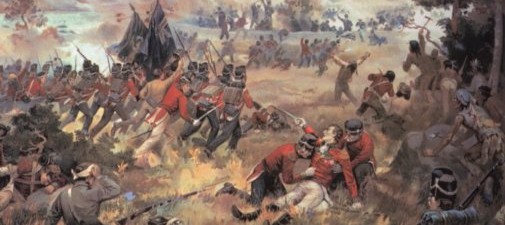
The US attacked with 2500 troops at Fort Malden where the only men General Brock had available was 150 British, 150
Indians and 300 Canadian militia (Loyalists), who knowing their fate if they failed, fought with such determination that
another 700 Indians and former slaves joined in to help out repelling the invaders.
Upper Canada would have been vitally under siege, but for the Federalists in New England and Vermont who wanted nothing to
do with this war and continued to trade and supply the British and along with the loyalists in Nova Scotia and New Brunswick
helped them to continue to hold out.
Over the next two years the USA deployed considerably more resources than struggling Britain and Canada were able to,
(who’s only ace was a naval blockade) and as a consequence gained territory.
An interesting factor was that some US troops, mainly those that had travelled all that way from the southern States, then
used their right on several occasions not to cross into Canada, maybe they saw through their leaders rhetoric ?
As one would expect, the audacious USA employed a range of warring tactics, including proving (while on raiding parties) that
they were still not above, their old tricks of committing atrocities against loyalists, at such places as York (Toronto),
Port Dover, Port Talbot, Turkey Point and Long Point.
But it’s a tribute to the defenders that the US never achieved a decisive tactical advantage.
When Napoleon bit off more than he could chew and suffered a major setback in Russia, Britain could at last reinforce her
beleaguered Canadian army, to at least match the USA’s and allow it to go on the offensive. Firstly to regain lost territory,
then to take Maine. As a reprisal for York, they set fire
to all public buildings in Washington, badly scorching the Presidential Mansion, so much so that it had to be whitewashed,
they now call it the White House.
Then because British shipping had been suffering at the hands of pirates operating out of
Baltimore, the Royal Navy was
sent to curtail their activities. The pirates however had anticipated this and took the initiative by scuttling all their
ships themselves to seal off the harbour from attack.
So to make sure they had got the point the British treated Fort McHenry to a rocket bombardment which together with
Mary Pickersgill’s splendid ensign, gave Francis Key the inspiration to write a poem to the melody of an old British
drinking song that is now the US national anthem
Thereafter with no sensible land objectives left, the British went on to lose a pivotal battle at
Lake Champlain, where
Captain Downie was badly let down and killed, then with the sudden disappearance of a covering mist while advancing
through boggy ground they took heavy losses at New Orleans,
just a day before news arrived that a peace treaty had been signed weeks earlier, making this the most tragic battle of
this ill-conceived war.
The war was considered a disaster, predictably the US claimed they had won (as Madison’s neck was on the line), peace was
declared and relations were normalised.
In an effort to try again, to get the Loyalist issues settled, the British gave up most of Maine (the exception was a
disputed border area). The US not being content with this then indulged in some posturing and declared the phoney Aroostook
war.
Britain then even conceded most of this disputed area on the solemn understanding that the USA would make every effort and
to earnestly resolve the lingering Loyalist issues.
But true to form they not only reneged on this again, they exposed their vindictive nature by persecuting those amongst
them (Federalists) that had opposed the war.
Since then US historians have largely ignored the existence of Loyalists, if mentioned at all, they underestimate their
numbers (to typically 15-20% of population) by conveniently ignoring that, those robbed of everything, made homeless,
reduced to mere survival, would have lacked the time or means to record their experiences and as their existence passes
from memory, any papers that do exist are scattered and buried under a barrage of opposing jingoism. Therefore an honourable
people subjected to the cruellest treatment, forcing all too many of them into suicide, continue to be victimised by
a negative portrayal.
The Loyalists are demonised or dismissed as simply obtuse and their crime of not wanting to live under mob rule, chaos,
insecurity, huge debts and the certainty of an ensuing civil war for the next 100 years or so, has in the eyes of the USA,
forfeited them any rights.
And their only 'crime' is remaining the ‘Good Americans’.


 1. The settlers were to stop taking more and more Indian land, to limit spiralling defence costs and adding to the
debt burden
1. The settlers were to stop taking more and more Indian land, to limit spiralling defence costs and adding to the
debt burden